Publishing an academic article is only the first step in contributing to public health research. The impact that comes after publishing is what truly matters.
Jenay Beer, associate professor and co-founder of the Cognitive Aging Research and Education (CARE) Center at the University of Georgia College of Public Health, emphasizes the importance of public health as it influences a number of disciplines including policy, technology and healthcare.
To ensure CPH continues to foster change, the college is partnering with the University of Georgia’s Innovation District to award four faculty members with up to $25,000 each to conduct public health research that turns research into action.
As CPH’s Innovation Fellow, Beer aims to educate faculty on the resources the Innovation District has to offer and help them turn their research ideas into tangible products that benefit the public.
“I think adding the guidance of the Innovation District really helps ensure that our products are viable,” Beer said, “that they can be out there and used and available for all.”
The four teams include:
- Renato F. L. Azevedo: Institute of Gerontology (IOG), Epidemiology and Biostatistics Assistant Professor
- Suhang Song: Health Policy and Management Assistant Professor
- Wentao Li: Environmental Health Science Assistant Professor
- Melanie Waddell (lead researcher): Institute for Disaster Management (IDM) Scientific Writer & Morgan Taylor: IDM Director

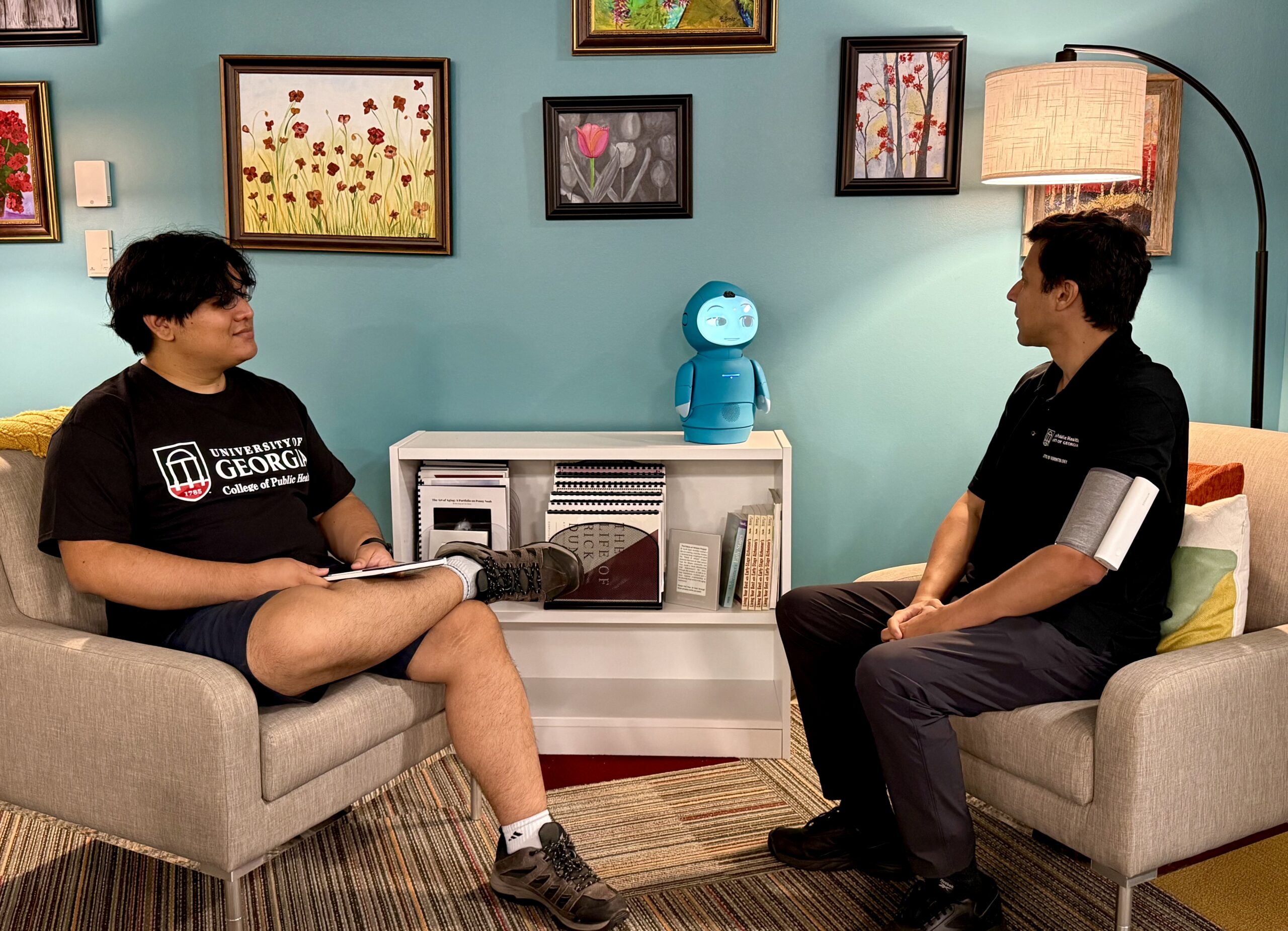
Phillip Li, computer science major (left) and Renato Azevedo, Innovation District grant winner (right) use Moxie, the AI-powered robot to read Azevedo’s blood pressure.
Renato Azevedo: Advancing Blood Pressure Visualizations in Emerging Health Technologies
According to the CDC’s National Center for Health Statistics, high blood pressure (hypertension) is the most common chronic condition among adults ages 85 or older, increasing their risk of heart disease, heart attack and stroke, with 61% of adults ages 65 and older struggle with hypertension facing these same risks.
With the support of the Innovation District grant, Azevedo hopes to allow people to better understand the risks associated with hypertension and how to manage it.
“We have an ethical responsibility to help people understand their results,” Azevedo said. “They can make the decision, but empowering people to understand the impact of their health is important and the first step to informed decision-making and encourage positive health behaviors.”
Azevedo turned the traditional American Heart Association blood pressure table into a visualization similar to a car speedometer which allowed older adults to better understand their blood pressure results.
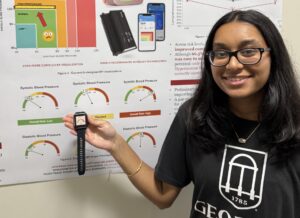
Nikita Neeli, computer science major presents the smartwatch prototype created by Renato Azevedo, Innovation District grant winner.
The Innovation District grant will enable Azevedo to take his research a few steps further. The first step includes testing his prototype on a smartwatch and evaluating its results.
One central idea is, if older adults are able to understand their blood pressure readings on a screen as small as a watch, they should be able to understand it on a larger screen such as a phone or computer.
The technology doesn’t stop there. Azevedo also plans to program a robot to read a patient’s blood pressure and explain the results. He hopes to introduce the robot in the CARE Center by this fall to collect feedback on patient experience.
“So the robot is helping you on that process both as a companion, not just a machine that you put your arm in and you get a number, but also explaining what this number means,” Azevedo said.
Suhang Song: AI Dementia Policy Intelligence: Advancing Rural–Urban Health Equity in Georgia
Song plans to use the Innovation District grant to explore how AI-assisted tools can help gather, analyze and summarize research on dementia policies affecting rural and urban communities in Georgia.
While there are a few research summaries related to the modifiable lifestyle factors associated with dementia, there are none focused on dementia policy.
Dementia mortality rates differ between rural and urban communities in Georgia. A 2025 UGA study found that rural Georgians have limited access to dementia related care compared to urban Georgians.
“So we would like to focus on, if it would be more helpful to use the policies or interventions to help those people living in either rural or urban areas,” Song said.
The project will develop and test ways researchers can use AI tools to review research on dementia policies and assess how that research applies to rural and urban populations.
The research team will also seek feedback from experts in public health and dementia on this approach.
“Our goal is to make a large and complex body of research more accessible and useful for public health decision-making,” Song said.
Wentao Li: A Universal DNA Damage Mapping and Mutation Prediction Platform
From technology to healthcare, AI is impacting almost every field and continues to evolve everyday. To capitalize on this advancement, Li is developing an integrated platform designed to map environmentally induced DNA damage and evaluate its potential to contribute to mutation formation.
“Eventually we want to identify environmental factors that contribute to cancer and develop predictive tools that could help inform cancer prevention.” Li said.
Some of these environmental factors that contribute to DNA damage include UV radiation which is linked to skin cancer and tobacco smoke which contains carcinogens that lead to DNA mutations called adducts.
Current methods for studying DNA damage are limited.
“We would like to develop a more broadly applicable approach for studying different forms of environmentally induced DNA damage,” Li said.
By understanding risks earlier, researchers may be able to better determine how environmental and lifestyle factors contribute to cancer development and support more effective prevention strategies.
“Prevention, I think, is more important than treatment,” Li said.
Once this platform is finalized, Li would like to patent it and build a startup company to serve the science community and the public.
 Melanie Waddell: Exercise Documentation App
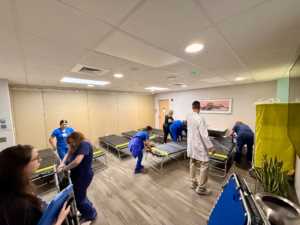
Whether it’s preparing for a medical surge in a hospital or preparing for extreme weather at a university, emergency preparedness drills are vital in every environment. Waddell and her co-researcher Taylor, aim to create an exercise documentation app that helps these drills run smoother.
In addition to the disaster management courses provided to CPH undergraduate and graduate students, IDM performs disaster training exercises outside of the classroom and conducts disaster management research.
Through their research, Waddell and her team found that during a medical surge exercise, it was difficult for participants to accurately and quickly document the events that transpired.
“When you’re thinking about these training exercises, they’re still happening on paper,” Waddell said. “And so that’s really difficult because then those have to be transcribed at the end of the exercise.”
Medical surges happen after a mass casualty event when hospitals become inundated with a large number of patients in a short period of time. Asking medical personnel to not only participate in the exercise but document their thoughts while still performing their daily duties can be a lot to ask.
“The goal is during the exercise, they’re able to write down their thoughts, their observations, so that we can get potential issues, potential solutions to the people who care quicker,” Waddell said.
Bringing these notes and exercise details together in an app will not only help trainees debrief and return to key lessons learned, but it will also provide a source to strengthen future exercises.
After the year-long Innovation District grant ends, Waddell hopes to have created a completely functional app that has been beta-tested in at least one pilot implementation.
The Innovation District is for everyone
Beer said there is a common misconception that the Innovation District only provides niche resources. In fact, she said the district applies to nearly every faculty member whether they realize it or not.
“The fact that we have these four amazing teams stepping up and getting involved, I think is testament to how much the Innovation District has to offer,” Beer said.
To Waddell, it is important for public health researchers to know about the resources the Innovation District provides as they are in the business of helping others. She said Beer has done a fantastic job of making sure CPH faculty and staff are aware of these resources.
“It’s really helpful to be able to diversify and then expand that reach even further,” Waddell said. “So that has been, I think, a shift in thinking for me and for our team to be like, maybe there are options for this.”